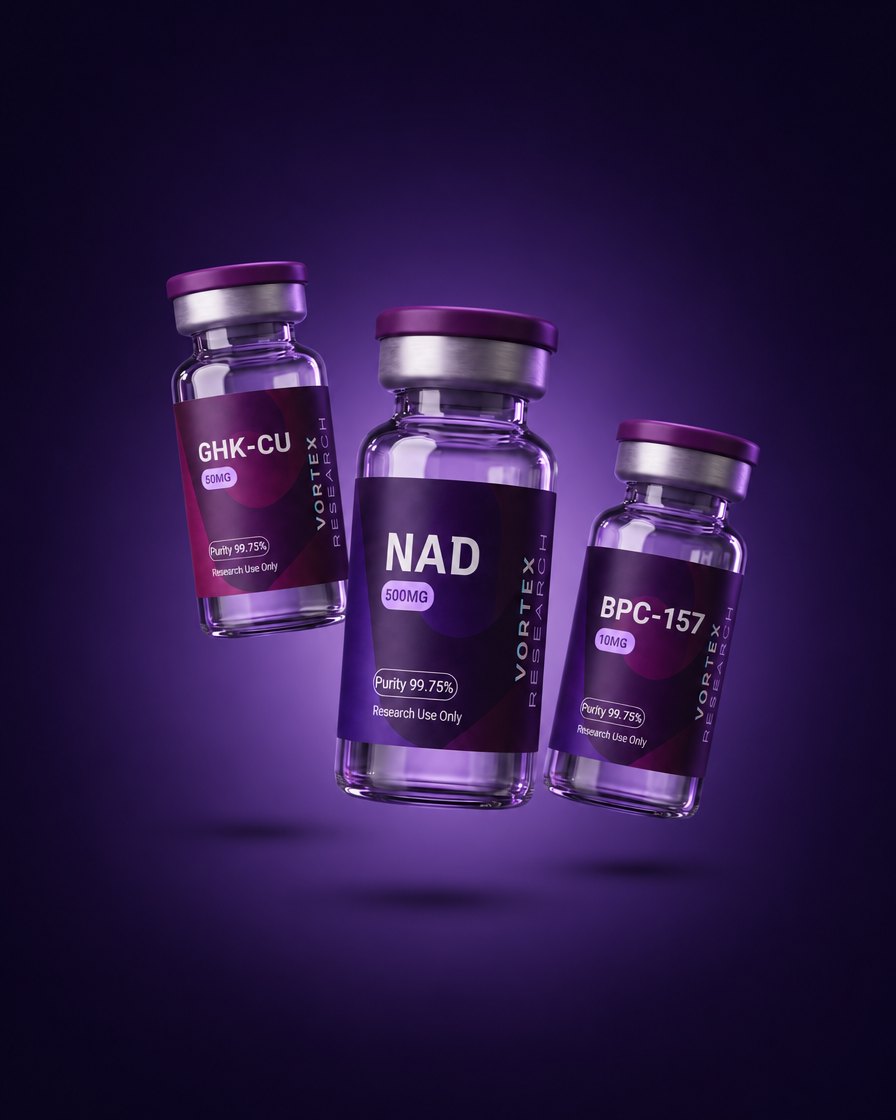

Peptide shelf life has no single figure. For a sealed lyophilised solid, it is a claim tied to one sequence, salt form, formulation, container and storage temperature, and it needs stability data behind it. The dry solid still changes slowly. In one study, a lyophilised 34-residue peptide held at 37 °C showed HPLC purity above 96% after drying, above 90% at 8 weeks and above 80% at 26 weeks [5].
Peptide shelf life at a glance
| Question | Short answer |
|---|---|
| Is there one shelf life for lyophilised peptides? | No. Rates depend on temperature, moisture, excipients and the physical state of the solid [2], and on sequence [9, 10] |
| Does a dry solid stop changing? | No. Deamidation, bond cleavage, oxidation and aggregation all occur in the solid state [2] |
| Shelf life or retest date? | A shelf life is a period within specification under labelled conditions. A retest date is when material is examined again [1] |
| What supports a freezer claim? | Real-time data at the long-term condition, in the ICH framework [1] |
| What does a lab report show? | One lot on one date. It is not a stability study |
Source: references as numbered. ICH Q1A(R2) sets out stability-testing terms for regulated products, and research reagents sit outside it. Its terms are used here for definitions only.
Research materials: Vortex supplies MOTS-c as a lyophilised research reagent: MOTS-c peptide 10mg. Lab reports: /coa/.
What peptide shelf life means
Three dates are often run together. They answer different questions.
- Shelf life: the period in which a product is expected to stay within its shelf life specification, when stored as its label defines [1].
- Retest date: the date after which samples should be examined to confirm the material still meets its specification [1].
- Report date: the date a lab measured one sample. It says nothing about the next day.
ICH also defines long-term testing as study under the recommended storage condition for the proposed period [1]. So a shelf life is an output of a study design. It is not a property of peptides in general.
Do lyophilized peptides expire?
Not in the sense of a chemical event on a set date. Degradation in the solid is continuous, and an expiry or retest date marks where a specification and a data set say to stop relying on the earlier result. A lot just past such a date has not changed on that day. A vial well inside one is only as reliable as the study and the storage behind it. Only an analytical retest shows the state of a specific older lot.
Why a sealed peptide solid still changes
The pathways are set out in the explainer on storing lyophilised peptides. A review of solid-state chemistry lists deamidation, peptide-bond cleavage, oxidation, the Maillard reaction, beta-elimination and dimerisation or aggregation [2]. What matters for shelf life is that the sequence decides which of these apply.
MOTS-c shows how to read a sequence for this. It has 16 residues: MRWQEMGYIFYPRKLR. Methionine, cysteine, histidine, tryptophan and tyrosine are the residues most prone to oxidation [3].
| Feature | In MOTS-c | What it points to |
|---|---|---|
| Oxidation-prone residues | Met1, Trp3, Met6, Tyr8, Tyr11 | Sulfoxide at methionine; each added oxygen adds about 16 Da |
| Cysteine | None | No thiol to form a disulfide |
| Asparagine | None | No Asn deamidation site |
| Aspartic acid | None | No Asp-Pro or Asp-Gly bond |
Source: our reading of the sequence, using reference 3 for residues. This shows where to look. It is not stability data for MOTS-c, and it says nothing about rate.
One added oxygen would move the [M+H]+ ion from 2174.12 to about 2190.11 (our calculation). A retention-time identity result prints no mass, so a retention-time identity result of that kind cannot show this shift. PubMed searches for this article found no solid-state stability study of MOTS-c.
What measured peptide shelf-life data show
The solid-state data found for this article are mostly short or accelerated, and much of the work uses model peptides or proteins. They still show the size of the effects.
| Material | Conditions | Time | Reported |
|---|---|---|---|
| hPTH(1-34), bulk lyophilisate [5] | 37 °C | 26 weeks | HPLC purity above 96% after drying, above 90% at 8 weeks, above 80% at 26 weeks |
| Secretin, lyophilised with mannitol [6] | -20, 4 and 25 °C; 25 °C at 60% RH | 8 weeks | HPLC figure lower by 20 to 27% by week 8. The abstract does not assign this to one condition |
| Human insulin solid, as a model peptide [7] | 25, 40 and 60 °C; 1, 33 and 75% RH | 6 months | Rates rose with temperature. Humidity had minimal effect at 25 and 40 °C and mattered at 60 °C |
| Antibody lyophilisate, not a peptide [8] | 5 to 50 °C; 1 to 8% moisture | 6 or 12 months | All formulations stable at 5 °C. High moisture lowered chemical stability |
Source: abstracts of references 5 to 8. Formulations differ, so the rows cannot be ranked against one another.
These searches found no multi-year, real-time study of a sealed synthetic research peptide. That does not prove none exists. It does mean a multi-year figure needs its own source.
Small changes in the solid change the answer
- One residue. For lyophilised Val-Tyr-Pro-Asn-Gly-Ala, the pH before drying had the main effect, and moisture and temperature mattered less [9]. For the Asp version of the same hexapeptide, pH was not significant, while moisture, temperature and especially the bulking agent were [10].
- Salt form. For lyophilised substance P, the acetate salt lost N-terminal dipeptides through diketopiperazines. The hydrochloride and trifluoroacetate salts were considerably more stable [11].
- Physical state. For model peptides in lyophilised solids at 37 °C, deamidation rate constants fell by about four orders of magnitude in glassy solids [12].
- Neighbouring residues. In model peptides, the residue after the Asn changed the deamidation rate in the solid [13].
Accelerated shelf-life estimates and their limits
The classic indirect method stores samples at elevated temperatures, compares them with samples kept cold, fits the Arrhenius equation and predicts stability at the normal condition [14]. For lyophiles, a review found that the equation fits in most cases, with a break near the glass transition in some. Most reported activation energies fell between 8 and 25 kcal/mol [15].
That range is wide enough to matter. Take a hypothetical 26 weeks at 37 °C and ask what it equals at -20 °C:
| Assumed activation energy | Rate ratio, 37 °C vs -20 °C | 26 weeks at 37 °C maps to |
|---|---|---|
| 8 kcal/mol | About 19 times | About 9 years |
| 19.9 kcal/mol | About 1,400 times | About 700 years |
| 25 kcal/mol | About 9,300 times | About 4,600 years |
Source: our Arrhenius arithmetic across the range in reference 15; 19.9 kcal/mol is the default used in mean kinetic temperature calculations. This is a hypothetical illustration, not a prediction for any peptide.
The spread is the point. An estimate from one temperature, with an assumed activation energy, can say almost anything. The review accepts extrapolation only where specific conditions are met [15]. ICH bases a freezer retest period on real-time data, and it allows limited extrapolation beyond the observed range only with justification [1]. The peptide fridge explainer applies the same equation to 5 °C and -20 °C.
What a peptide stability claim should state
A line such as “stable for two years” cannot be checked as written. A checkable claim states the following.
| Element | What it should say | Why |
|---|---|---|
| Material | Sequence, termini and salt form | Salt form changed the stability of substance P [11] |
| Formulation | Every excipient | Bulking agent type mattered [10]. Reducing-sugar impurities in mannitol oxidised a lyophilised peptide [16]. Mannitol has also turned up undeclared, at 20 and 43% w/w [17] |
| Container | Vial and stopper, same as or simulating the real pack | ICH asks for this [1]. Over long storage in humid conditions, moisture came through the stopper [18] |
| Storage condition | A number, for temperature and for humidity where relevant | ICH says to avoid terms such as “room temperature” and “ambient conditions” [1] |
| Evidence type | Real-time, accelerated, or an extrapolation, each labelled | See the table above |
| Time covered | The longest time point actually measured | Extrapolation assumes the same relationship continues [1] |
| Attributes and methods | Assay and degradation products, by a stability-indicating method | ICH asks that evaluation cover both [1] |
| Limit | The acceptance criterion the material had to stay within | A shelf life is defined against a specification [1] |
| Lots | How many were studied | ICH asks for at least three primary batches in a stability programme [1] |
| Start point | Manufacture, fill or test date | The same period gives a different end date from each |
Source: references as numbered. Element list compiled for this article.
Checking an older lot
The direct check is a new measurement compared with the original report, ideally at the same lab by the same method. A purity figure is a comparison within one run, so a change of method can move it with no change in the material. The HPLC peptide purity explainer covers that calculation.
Degradation products include oxidised residues, dimers, diketopiperazines, pyroglutamate and succinimides [4]. New or growing peaks point to change, and LC-MS can then suggest the pathway. Solid appearance is a weak signal, as the lyophilised peptides explainer sets out. Time in transit is covered in the cold-chain shipping explainer.
What Vortex lab reports show about shelf life
They do not establish one. The published Vortex lab-report dataset lists one test date per lot, and none of the lots in it appears twice. Vortex makes no shelf-life claim from them. Two GHK-Cu rows show why the figures cannot be read as a trend.
| Field | GHK-Cu 50 mg | GHK-Cu 100 mg |
|---|---|---|
| Lot | VR01-GHK | PS07-GHK100 |
| Lab | Freedom Diagnostics | ILS Laboratories |
| Report type | Tested for Vortex Research | Partner-facility report |
| Date | 06/20/2026 | 08/12/2026 |
| Purity | 99.85% (HPLC-UV) | 99.34% (HPLC) |
Source: Vortex lot report dataset (doi:10.5281/zenodo.23578844), read 5 November 2026. Both figures are as printed on the published reports.
The later figure is lower by 0.51 points. That is not degradation over 53 days. These are two lots and two labs, so the gap says nothing about time. A stability result needs one lot measured more than once, by one method. The explainer on reading a peptide COA covers the other report fields.
Research materials from Vortex Research. Lyophilised research peptides. Published lab reports name the lab, lot label and test date.
MOTS-c peptide 10mg → · View lab reports → · Browse the catalogue → · More from the research library →
Frequently asked questions
What is the shelf life of a lyophilised peptide?
There is no single figure. It depends on sequence, salt form, formulation, container, moisture and storage temperature. A shelf life applies only to the material and conditions studied, and it needs stability data behind it.
Do lyophilized peptides expire?
Degradation in the dry solid is slow and continuous, with no chemical event on a set date. An expiry or retest date comes from a specification and stability data. Only an analytical retest shows the state of a specific older lot.
What is the difference between a retest date and a shelf life?
In ICH terms, a shelf life is the period a product is expected to stay within specification under labelled conditions. A retest date is the date after which samples should be examined to confirm the material still meets its specification.
Can accelerated studies predict peptide shelf life?
Only under specific conditions. Most reported activation energies for lyophiles fall between 8 and 25 kcal/mol, and across that range 26 weeks at 37 °C maps to anything from about 9 to about 4,600 years at -20 °C. ICH bases a freezer retest period on real-time data.
Research materials: MOTS-c peptide 10mg is supplied as a lyophilised research reagent. Published lab reports are at /coa/.
About this article: Written by the Vortex Research Editorial Team. Sources are peer-reviewed papers indexed in PubMed, each checked for title, journal and year and matched to its abstract. Full texts were not read. Reference 1 is an ICH guideline, read in its published text and cited by name. Tables marked as arithmetic are our own calculations. Lab report figures are from the published dataset and reports.
References
- International Council for Harmonisation. ICH Q1A(R2): Stability Testing of New Drug Substances and Products. Step 4 version, 6 February 2003.
- Lai MC, Topp EM. Solid-state chemical stability of proteins and peptides. J Pharm Sci. 1999;88(5):489-500. PMID: 10229638. doi:10.1021/js980374e
- Li S, Schöneich C, Borchardt RT. Chemical instability of protein pharmaceuticals: mechanisms of oxidation and strategies for stabilization. Biotechnol Bioeng. 1995;48(5):490-500. PMID: 18623513. doi:10.1002/bit.260480511
- D’Hondt M, Bracke N, Taevernier L, et al. Related impurities in peptide medicines. J Pharm Biomed Anal. 2014;101:2-30. PMID: 25044089. doi:10.1016/j.jpba.2014.06.012
- Proos ER, Prescott JH, Staples MA. Long-term stability and in vitro release of hPTH(1-34) from a multi-reservoir array. Pharm Res. 2008;25(6):1387-1395. PMID: 18266089. doi:10.1007/s11095-008-9544-0
- Srinivasan C, Siddiqui A, Korang-Yeboah M, Khan MA. Stability characterization and appearance of particulates in a lyophilized formulation of a model peptide hormone-human secretin. Int J Pharm. 2015;481(1-2):104-113. PMID: 25636302. doi:10.1016/j.ijpharm.2015.01.044
- Fagan A, Bateman LM, O’Shea JP, Crean AM. Kinetics of human insulin degradation in the solid-state: an investigation of the effects of temperature and humidity. J Pharm Sci. 2025;114(2):1368-1375. PMID: 39725225. doi:10.1016/j.xphs.2024.11.032
- Breen ED, Curley JG, Overcashier DE, Hsu CC, Shire SJ. Effect of moisture on the stability of a lyophilized humanized monoclonal antibody formulation. Pharm Res. 2001;18(9):1345-1353. PMID: 11683251. doi:10.1023/a:1013054431517
- Oliyai C, Patel JP, Carr L, Borchardt RT. Solid state chemical instability of an asparaginyl residue in a model hexapeptide. J Pharm Sci Technol. 1994;48(3):167-173. PMID: 8069519
- Oliyai C, Patel JP, Carr L, Borchardt RT. Chemical pathways of peptide degradation. VII. Solid state chemical instability of an aspartyl residue in a model hexapeptide. Pharm Res. 1994;11(6):901-908. PMID: 7937533. doi:10.1023/a:1018998312503
- Kertscher U, Bienert M, Krause E, Sepetov NF, Mehlis B. Spontaneous chemical degradation of substance P in the solid phase and in solution. Int J Pept Protein Res. 1993;41(3):207-211. PMID: 7681812. doi:10.1111/j.1399-3011.1993.tb00328.x
- Krogmeier SL, Reddy DS, Vander Velde D, et al. Deamidation of model beta-turn cyclic peptides in the solid state. J Pharm Sci. 2005;94(12):2616-2631. PMID: 16258986. doi:10.1002/jps.20468
- Li B, Gorman EM, Moore KD, et al. Effects of acidic N + 1 residues on asparagine deamidation rates in solution and in the solid state. J Pharm Sci. 2005;94(3):666-675. PMID: 15668945. doi:10.1002/jps.20263
- Kirkwood TB. Predicting the stability of biological standards and products. Biometrics. 1977;33(4):736-742. PMID: 588659
- Shalaev E, Ohtake S, Moussa EM, Searles J, Nail S, Roberts CJ. Accelerated storage for shelf-life prediction of lyophiles: temperature dependence of degradation of amorphous small molecular weight drugs and proteins. J Pharm Sci. 2023;112(6):1509-1522. PMID: 36796635. doi:10.1016/j.xphs.2023.02.008
- Dubost DC, Kaufman MJ, Zimmerman JA, et al. Characterization of a solid state reaction product from a lyophilized formulation of a cyclic heptapeptide. A novel example of an excipient-induced oxidation. Pharm Res. 1996;13(12):1811-1814. PMID: 8987076. doi:10.1023/a:1016024923002
- Choules MP, Bisson J, Simmler C, et al. NMR reveals an undeclared constituent in custom synthetic peptides. J Pharm Biomed Anal. 2020;178:112915. PMID: 31671336. doi:10.1016/j.jpba.2019.112915
- Sasaki H, Kikuchi J, Maeda T, Kuboniwa H. Impact of different elastomer formulations on moisture permeation through stoppers used for lyophilized products stored under humid conditions. PDA J Pharm Sci Technol. 2010;64(1):63-70. PMID: 21502005
Vortex Research products are sold for in-vitro laboratory research by qualified researchers. Not for human or veterinary use. Not a drug, dietary supplement or cosmetic. Statements have not been evaluated by the FDA.
 Why Peptide Purity Varies by Batch: 9 Lot Reports (2026)Where lot-to-lot differences in peptide purity come from (synthesis, purification, freeze-drying and the measurement itself), and what nine published lot reports can and cannot…Read article →
 BPC-157 vs TB-500: What Research Exists on the PairWhat is published on BPC-157 and TB-500 as a pair: the identity of each molecule, why the two are discussed together, the single 2026…Read article →
 Copper Peptides: Coordination Chemistry of GHK-Cu and the ATCUN MotifA chemistry reference on copper peptides: how Cu(II) binds peptide nitrogens, the GHK-Cu and ATCUN binding motifs compared, what stability constants mean, how complexes…Read article →